Email and correspondence
Summarise a long thread, draft the reply in your own tone, translate an inbound message, and check a response before it goes out. In Outlook and Gmail, without the message leaving your control.
 R2 Copilot
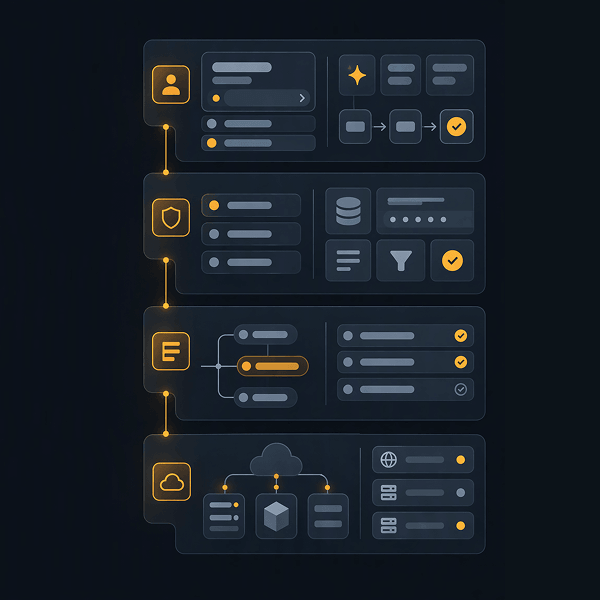
Features · what the layer actually controls
The work your team gets done, and the controls that make it allowable. Grouped the way a buyer evaluates it: what people do with it, what protects it, what governs it, and where it runs.
Summarise a long thread, draft the reply in your own tone, translate an inbound message, and check a response before it goes out. In Outlook and Gmail, without the message leaving your control.
Draft, rewrite, shorten, expand, compare versions and summarise a document you have been sent. In Word and Google Docs, on privileged material, without it entering a training set.
Build a formula from a description, clean an imported column, explain a sheet someone else built, and describe what a dataset shows. In Excel and Sheets, on data that cannot be uploaded anywhere.
Turn an outline into slides, tighten existing copy, and structure meeting notes as you take them. In PowerPoint, Slides and OneNote.
Catch up on a Teams thread, extract the decisions and the owners, and draft the follow-up in the channel.
The extension carries the same layer into your CRM, ticketing system, internal tools and any web app your team lives in.
One bill and one access list instead of a seat per model and a personal login per employee.
Pick the model that suits the job. The policy set, the logging and the encryption do not change when you switch.
Decide which groups may use which models. Restrict a model by department, by data class or by deployment mode.
Route requests by policy rather than by user choice, so sensitive data classes only ever reach approved destinations.
GPT, Claude, Gemini, Grok, Llama, DeepSeek R1 and open-weight models you host yourself.
Run open-weight models on your own infrastructure and reach them through the same interface as the commercial ones.
Encryption on the device
Prompts are encrypted where they are typed. Nothing readable crosses the network.
SDNP routing
Traffic is scrambled, split, mixed and repeatedly encrypted, then routed across independent nodes. No single node holds a complete message.
Last Mile Protection
A second patented layer covers the final leg between the node network and the user's device.
PII and PHI handling
Detection and handling rules applied before anything leaves the perimeter, configured to your data classes.
No retention by default
R2 stores no user-generated content as standard. Content is discarded when the add-in closes.
Tenant isolation
Your environment is separated from every other customer's, in every deployment mode.
Sign in with Microsoft, Google, Apple and other providers. Permissions map to your directory, so joiners and leavers are handled where you already handle them.
Every interaction is attributable to a person inside your organisation, even though it is not attributable to you at the model.
Rules by group, data class, model and deployment mode, enforced before the request leaves.
The audit record sits inside your deployment, not with us. R2 stores no user content of its own.
Who asked what, of which model, when, and as much of the exchange as your regulator requires.
Produce the record for an auditor or an examiner without reconstructing it from memory.
We operate the node network and the connection to commercial models. Nothing for you to host.
Open-weight models on your own infrastructure. Nothing leaves your network.
R2 in your tenant: AWS GovCloud, Azure Government, private VPC or air-gapped. Your keys, your region, your logs.
Enterprise deployments can use your own encryption keys.
Deploy in any region, so the environment sits where your regulator expects it.
Install and sign in. Custom and private environments are configured with our team on Enterprise.